With a long day ahead and few lunch choices near the airport, I made a sandwich detour. The woman behind the counter saw the cycling garb and asked where I had started and where I was headed. She was shocked, thinking it impossible or impractical to ride 16 miles to work in the morning and 16 miles home in the evening. I offered that I hadn't jumped into riding that sort of mileage, I eased into it. She claimed she could never ride a bike that far and I reminded her that each of us is capable of more than we realize.
Reaching the end of the 2013 and having completed my 56th lap around the sun, I find myself above my goal of 4500 cycling miles for the year. I've upped that goal to 6000 miles and with just under 5600 miles and a few weeks left to log the remaining 400 miles, I stopped to consider how far I'd come. With age comes wisdom and as I've grown older, my focus has shifted from my own needs to helping others. That sandwich shop chat got me thinking about what to suggest to readers who might want to undertake a bicycle commute, reduce their dependence on fossil fuel, shed some weight, improve their health, and generally feel more energetic about life.
1) Start Incrementally
First a disclaimer: Verify you are healthy enough to begin cycling by checking with your doctor or by getting a physical examination.
My commute routine started with a mile or so of cycling to BART, riding the train to a station near work, and cycling the remaining five miles. 12 miles round trip was tiring at first, so I'd alternate one day riding, one day driving. Often the train home was delayed and it began to dawn on me: If I could work up to cycling the whole way, I'd get home sooner. Occasionally I'd ride the whole way home. Then I began cycling to and from work and before I knew it, I had mostly abandoned BART. The key was starting with an intermodal solution and then gradually increasing my mileage. Try to do too much, too soon and you may give up before you've established the all important exercise habit pattern.
2) Find a Route
Most people say the number one reason they don't consider bicycling is the lack of separation from motor vehicles. Bike lanes, sharrows, and green lanes are great, but they don't guarantee protection from a collision with a car or truck. Mapping software like Google Maps or the interactive New York Times bike maps can help you discover a good route. Don't put your faith in any suggested route until you've verified it yourself. You may find that designated bike routes are actually less suitable than a routing you find yourself.
3) Form Good Habits
Exercising every day is a good way to ensure success, but realize that it can take as long as two or three months to work out the logistics and for the cycling habit to become engrained. Once you've established a pattern and worked out the kinks, driving to work will seem less and less appealing. If you have to spend time getting to work, why not spend some or all of that time doing something that will make you feel better?
What about arriving at work all sweaty? A lot depends on your circumstances, but with some planning and ingenuity those issues can be worked out. I carry two panniers: One is my flight bag containing my iPad mini, headset, and various supplies. The second pannier holds a change of clothes, a sweater, and my lunch. I use panniers because I don't like carrying things on my back while riding, but these solutions are individual in nature. Experiment and find what works for you.
4) Measure Your Progress
Regardless of your goal (sleep more, eat less, exercise more), you're more likely to succeed if you have a way to measuring your progress. I find the MapMyFitness iPhone app useful for tracking my weekly mileage and time spent riding. There are other apps and they all seem to have historical measurement and graphing tools. If, for example, you see your mileage increasing by more than one standard deviation, you're probably increasing your workouts too quickly.
5) Set Achievable Goals
Nothing will scuttle you faster than setting an overly ambitious goal. Better to set a less aggressive goal that you can meet or exceed. In my own case, I set a goal of riding 4500 miles for this year even though I suspected I could do more. When I met my goal early, I adjusted it upward. Time will tell if I make the 6000 mile mark, but I'll have fun in the process.
6) Pace Yourself
Once your exercise habit pattern is established, avoid being too aggressive with your routine. Americans live in an increasingly competitive, some might say militaristic, society. Don't fall victim to the mentality of "If a little exercise is good, then more must be better." Unless you're a comic book hero, over-training will lead to burn-out, injury, illness or just a bone-tired feeling that you can't shake. The flip side of exercise is rest: We all need rest. If you have entered your fourth decade or beyond on planet Earth, you're aware that you don't recover from injury as quickly as you used to. So be wise and avoid getting injured in the first place.
7) Expect the Unexpected
Regardless of your well-laid plans, illness, injury, saddle sores, over-training, and countless obstacles crop up for cycle commuters. If you've set a reasonable goal, you shouldn't have any trouble taking a few days off when you don't feel right or if you need time to heal.
You'll also need to be prepared for unexpected bike maintenance, usually a flat tire. Install puncture resistant tires, carry the necessary tools and supplies to fix a puncture, and have the skills to do the work. Knowing how to make simple repairs in adverse conditions will serve you well.
What about rain, snow, and other icky weather, you ask? California generally has benign weather compared to where I spent my formative years (Chicago area), but things can still get nasty. Rain, strong winds, and cold temperatures with high relative humidity provide plenty of reasons to throw in the towel and just drive. My motto: "There's no such thing as poor cycling weather, only poor preparation." Fenders, shoe covers, riding tights, insulated gloves, helmet covers, and good cycling lights (front and rear) are excellent investments. Get equipped, get over the hump, get out the door, and you'll find things are not as bad they seem.
A side benefit of cycling is that you will regularly encounter unexpected moments of beauty and awe. It could be wildlife, a breathtaking sunrise or sunset, the stillness of a gentle snow fall, or the mystery of a thick fog. Consider carrying a camera and recording what you see, share these inspiring moments with others, but by all means slow down, appreciate, and enjoy.
8) Manage Risks
Reducing risk on a bike boils down to being visible, wearing a helmet, and riding responsibly and defensively. It may not be fashionable, but bright clothing and lights (front and rear) reduce the risk you'll collide with a motor vehicle or pedestrian. If you find yourself resistant to wearing a helmet, ask yourself this: Do you want to experience a traumatic a brain injury when your noggin hits the pavement? Will you enjoy relearning the alphabet in a rehab facility while your significant other feeds you soup from a spoon? In addition to wearing a helmet, ride responsibly and follow the rules of the road. There's a difference between executing an Idaho Stop at a deserted intersection and acting like a selfish jerk in heavy traffic. Don't ride like a jerk!
9) Care for Your Ride
Once a week, clean your bike, check your tire pressure, oil your chain (if you're still using a chain), and check the condition of your brakes. A little preventative attention now can prevent a roadside repair at an inopportune time and location. I've learned this the hard way. Few things match the unwanted excitement of making a tire repair on a dark and lonely urban street in a pouring rain.
10) Be an Example for Others
When people you know or work with see you have adopted bicycle commuting, they may question your mental health. There's no need to try to sell others on the virtues of using a bike as transportation. The very fact that you arrive by bike and that you look and feel great is all the evidence others will need to adjust their commuting priorities.
Showing posts with label health and wellness. Show all posts
Showing posts with label health and wellness. Show all posts
Sunday, December 1, 2013

Monday, July 8, 2013
Time in a Barrel
Reading Bill McKibben's book, Eaarth: Making a Life on a Tough New Planet, I was struck by his illustration of how much human power is equivalent to the energy contained in a single barrel of oil. 42 gallons of oil equals about 25,000 hours (or more than a decade) of one human being's labor and that, along with natural gas and coal, has provided humankind with a sort of time machine: By combining the energy stored in fossil fuel with human ingenuity, we started the industrial revolution and in the process we changed our earth forever. We created machines and infrastructure that allow us to travel vast distances in a matter of hours. Communication systems allow us to exchange data and ideas, such as this blog. Data can travel around the world in a matter of seconds. By letting us accomplish so much in such a short period of time, fossil fuel has altered our consciousness.
We don't perceive or value time and energy the way our ancestors did because with fossil fuel, we can fold time and space. Walk outside your home or office, stand by a stop sign, wait for a car to appear, and you'll see something that happens hundreds of thousands of times each day. The driver will bring their car to a stop (hopefully) and then accelerate away from the stop. Depending on how aggressive, frustrated, or relaxed the driver is feeling, they may accelerate slowly (using less fuel) or rapidly (using a more fuel). What the driver probably doesn't appreciate is the benefit provided by their car's engine and the fuel it is burning: They are moving a ton or so of metal, rubber, plastic, themselves, their passengers, and their cargo by simply extending the toes of their right foot. Put the same cargo onto a bicycle, turn the driver into the engine, and you will dramatically realign their awareness of energy, time, and space.
The compression of time and space provided by fossil fuel, along with the increase in available activities and goods, has changed the way we value those goods and activities. We spend a lot more time sitting, observing, and thinking. We tend to drive more and walk less. With less physical activity, we are more obese and more likely to suffer from diabetes, high blood pressure, and cardiac disease. We expend less physical energy, but we complain that there aren't enough hours in a day to accomplish all we'd like to accomplish. Without an appreciation of the labor that goes into cultivating food, we aren't troubled by wasting food. Forced to walk or bicycle the 32 miles the average American commutes to work each day, most of us would choose to live closer to work, or find work closer to where we live, or allot considerably more than the 52 minutes the average American spends commuting. Forced to walk to the grocery, we make more thoughtful choices and have a greater appreciation of our resources. Which gets us back to the crux of our predicament.
With dwindling fossil fuel reserves and climate change already underway, McKibben has been exploring the myriad of issues we will soon face: What sort of work we will do, how we'll meet our transportation needs, what sorts of food will be available, and where will we find clean water. It's a huge topic, so big that most of us can't get our minds around it. We have catapulted ourselves into the future, but soon we'll begin to decelerate and we'll need to adjust our priorities and values. A good place to start is to cultivate an appreciation of how much human labor is contained in a barrel of oil, a gallon of gasoline, even a 60 watt light bulb. Forget carbon offsets and all the other distractions. Getting your mind around renewable energy, human-powered activities and locally-based economies are the first steps toward preparing for the future.
We don't perceive or value time and energy the way our ancestors did because with fossil fuel, we can fold time and space. Walk outside your home or office, stand by a stop sign, wait for a car to appear, and you'll see something that happens hundreds of thousands of times each day. The driver will bring their car to a stop (hopefully) and then accelerate away from the stop. Depending on how aggressive, frustrated, or relaxed the driver is feeling, they may accelerate slowly (using less fuel) or rapidly (using a more fuel). What the driver probably doesn't appreciate is the benefit provided by their car's engine and the fuel it is burning: They are moving a ton or so of metal, rubber, plastic, themselves, their passengers, and their cargo by simply extending the toes of their right foot. Put the same cargo onto a bicycle, turn the driver into the engine, and you will dramatically realign their awareness of energy, time, and space.
The compression of time and space provided by fossil fuel, along with the increase in available activities and goods, has changed the way we value those goods and activities. We spend a lot more time sitting, observing, and thinking. We tend to drive more and walk less. With less physical activity, we are more obese and more likely to suffer from diabetes, high blood pressure, and cardiac disease. We expend less physical energy, but we complain that there aren't enough hours in a day to accomplish all we'd like to accomplish. Without an appreciation of the labor that goes into cultivating food, we aren't troubled by wasting food. Forced to walk or bicycle the 32 miles the average American commutes to work each day, most of us would choose to live closer to work, or find work closer to where we live, or allot considerably more than the 52 minutes the average American spends commuting. Forced to walk to the grocery, we make more thoughtful choices and have a greater appreciation of our resources. Which gets us back to the crux of our predicament.
With dwindling fossil fuel reserves and climate change already underway, McKibben has been exploring the myriad of issues we will soon face: What sort of work we will do, how we'll meet our transportation needs, what sorts of food will be available, and where will we find clean water. It's a huge topic, so big that most of us can't get our minds around it. We have catapulted ourselves into the future, but soon we'll begin to decelerate and we'll need to adjust our priorities and values. A good place to start is to cultivate an appreciation of how much human labor is contained in a barrel of oil, a gallon of gasoline, even a 60 watt light bulb. Forget carbon offsets and all the other distractions. Getting your mind around renewable energy, human-powered activities and locally-based economies are the first steps toward preparing for the future.
Monday, June 24, 2013
TTCBCOAB #50, Cycling Goals, and Privacy
Here are some things that can be carried on a bicycle, from a recent Costco run. It's much easier to negotiate the parking lot on a bike rather than a car. I park right by the entrance and lock up my bike, which makes for a pleasant and quick escape. Plus, I can ride through the gaps in the parking lot speed bumps. Sweet!
Milestones
My stated goal for this year is to log 4500 commuting miles on my various bikes. Halfway through this year my running total stands at 2700 miles, which is well over the 2250 miles I expected. Assuming no hideously bad weather this fall, I may very well exceed that goal. I use MapMyRide to track my mileage and have found it a very useful service. It's easier to stay motivated when you have a measurement of how you are doing.
Got Privacy?
The recent revelations about the NSA data collection and surveillance (which many of us already suspected was occurring) got me to thinking about privacy and how we unconsciously change our behavior when we think someone is watching us. Chatting with many friends and acquaintances, I discovered they are thinking about expectations of privacy, too. So what's a law-abiding citizen to do? Here's my top ten list:
 |
| Various odds and ends That Can Be Carried On A Bicycle... |
My stated goal for this year is to log 4500 commuting miles on my various bikes. Halfway through this year my running total stands at 2700 miles, which is well over the 2250 miles I expected. Assuming no hideously bad weather this fall, I may very well exceed that goal. I use MapMyRide to track my mileage and have found it a very useful service. It's easier to stay motivated when you have a measurement of how you are doing.
 |
| Stats, courtesy of MapMyRide |
Got Privacy?
The recent revelations about the NSA data collection and surveillance (which many of us already suspected was occurring) got me to thinking about privacy and how we unconsciously change our behavior when we think someone is watching us. Chatting with many friends and acquaintances, I discovered they are thinking about expectations of privacy, too. So what's a law-abiding citizen to do? Here's my top ten list:
- Ensure you have a good password on your all your devices.
- Enable FileVault, BitLocker, or an equivalent product to encrypt your hard disk.
- Use an anti-virus prorgam to regularly scan your computer.
- Install Tor and use it for anonymous browsing.
- Install Gnu Privacy Guard on your computer (I use GPGmail).
- Encrypt your email and encourage your friends to do the same.
- Install a version of GPG on your mobile device (I use ipgmail for iOS).
- If you access email with a browser, consider using mailvelope .
- Make a donation to the Electronic Freedom Foundation.
- Tell your senators and congressional representative that privacy is important to you.
Sunday, June 9, 2013
TTCBCOAB #44 & Finding the Way Up
My wife fell and broke her wrist yesterday, so grocery shopping was done by car today. I did an earlier trip by bike, carrying a lighter than usual load: 8 pound bag of dog food, 2 pounds of dog biscuits, and a Schilke B-flat trumpet.

Looking UP

Looking UP
Two weeks ago, while waiting for my iPhone to be restored at the local Apple Store, I had plenty of time to browse the aisles (It's entrapment I tell you, entrapment!). That's when I noticed the Jawbone Up. It's one of a new class of electronic activity trackers that are tapping into growing awareness about how movement (or lack thereof) affects human health. Some studies indicate that being inactive at a desk (or at the controls of an aircraft) for hours on end can have a health outcome similar to smoking cigarettes. What I've noticed about human beings (myself included) is that it is easier to change our behavior if we enhance our awareness of our behavior. I've seen this with hybrid vehicles: Give a driver real-time feedback on how much gas they're burning and they are more likely to reorder their driving goals and adjust their driving technique.
The Jawbone seemed like a pedometer on steroids, so I bought one for my wife who had broken her mechanical pedometer and had given up tracking how many steps she was walking per day. After watching her use it for a week and announce proudly one day that she had walked 16,000 steps, 1000 more steps than the average Amish man, I was impressed! She had rededicated herself to being active and, more importantly, was enthusiastic about it. There were other features that helped me decide I wanted to try a Jawbone, too.
The device is unobtrusive. A lightweight bracelet you wear, preferably on the wrist of your non-dominant hand, it contains accelerometers and other electronics that, together with iOS- or Android-based software, can track your daily activities, your sleep, even the food you eat. I chose to wear mine on my right wrist, even though I'm right-handed.

To find out how active you've been or how well you slept, you plug the Jawbone Up into your iPhone, iPad, or Android device and launch the free Up application, available for iOS and Android. The device plugs into the audio jack and a separate USB charger is provided. The fully-charged battery lasts about 10 days. There is a single push button that you use (in Morse code fashion) to access the basic modes: Awake, Sleep, activity timer, and Power Nap.

Once you've synced with your iOS or Android device, the app will give you an overview of your activity and some details about your sleep the night before. It will also tell you the current state of you battery charge.

I've found the information on how much sleep I've been getting to be very interesting. In short, I was not sleeping as much as I thought so I've adjusted my schedule to sleep more. I've blogged before on the subject of adequate sleep. There's plenty of research that shows most people need more sleep than they are getting. And when people don't get enough sleep, one of the side-effects is that they actually don't realize that they are impaired. I do quite a bit of physical activity with bike commuting, so quality sleep is especially important. After adjusting my sleep schedule I've found that I seem to be recovering more completely from the previous day's ride.

The app lets provides a historical view of your activity that is both intuitive and inspiring. Recently, the Up app was updated to share data with other fitness apps, including the one I use to track my cycling - MapMyFitness.


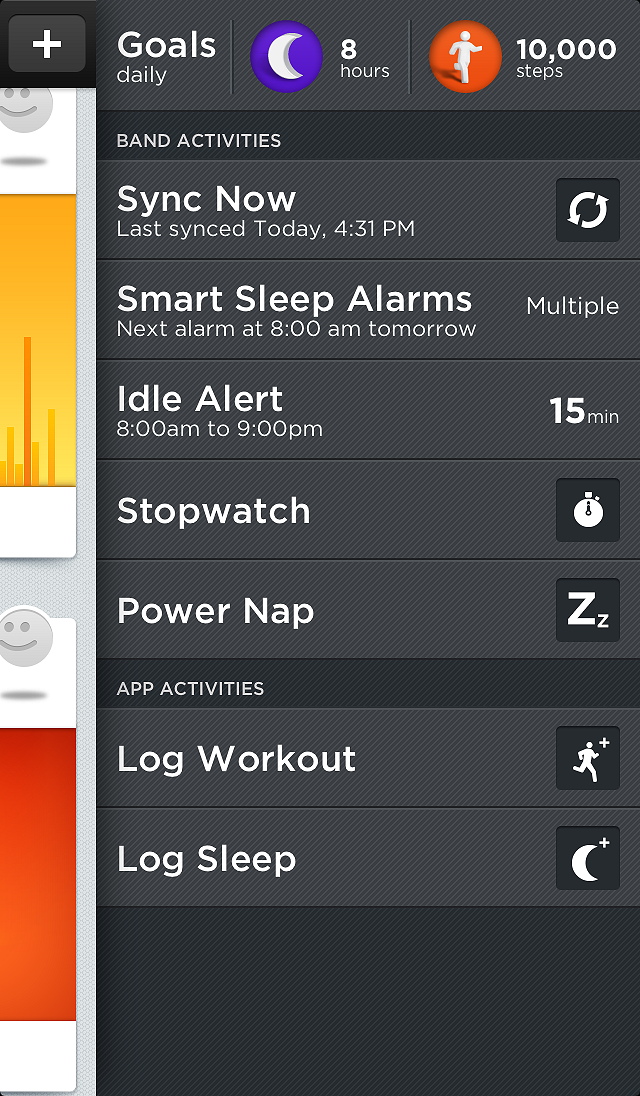
There are a few other useful features. One is an activity alarm that reminds you to move when you've been sitting for too long. You can adjust the inactive interval with the Up app. When you've been inactive, the bracelet will vibrate to remind you to stand up, walk around, or at least stretch or wiggle in your seat (what I do when teaching in a small aircraft).
You can activate the Power Nap feature by pressing the bracelet button twice, once quickly followed by a slightly longer second push (in Morse code lingo, this would be dot-dash). Again, the Up app lets you set the maximum length of the Power Nap feature and the bracelet will vibrate to wake you at what it thinks is the optimum point in the nap.
This brings up the last, and I think one of the more useful features: The Smart Sleep Alarms for morning wake-up. You set the time you want to wake up for different days and the bracelet will vibrate to wake you at what it thinks is the optimum point in your sleep cycle within a 20 minute window of your desired wake-up. I get up earlier than my wife does and the vibrating bracelet wakes me while allowing her to continue to snooze. Pretty awesome ...

These new activity monitors promise to change the way we live, work and play. Given that most of us work long hours, inside rather than outside, and we're often sitting for extended periods, having more information on how we are treating our bodies in our competitive society and workplace can allow us to influence our individual health in a positive way.

To find out how active you've been or how well you slept, you plug the Jawbone Up into your iPhone, iPad, or Android device and launch the free Up application, available for iOS and Android. The device plugs into the audio jack and a separate USB charger is provided. The fully-charged battery lasts about 10 days. There is a single push button that you use (in Morse code fashion) to access the basic modes: Awake, Sleep, activity timer, and Power Nap.

Once you've synced with your iOS or Android device, the app will give you an overview of your activity and some details about your sleep the night before. It will also tell you the current state of you battery charge.

I've found the information on how much sleep I've been getting to be very interesting. In short, I was not sleeping as much as I thought so I've adjusted my schedule to sleep more. I've blogged before on the subject of adequate sleep. There's plenty of research that shows most people need more sleep than they are getting. And when people don't get enough sleep, one of the side-effects is that they actually don't realize that they are impaired. I do quite a bit of physical activity with bike commuting, so quality sleep is especially important. After adjusting my sleep schedule I've found that I seem to be recovering more completely from the previous day's ride.

The app lets provides a historical view of your activity that is both intuitive and inspiring. Recently, the Up app was updated to share data with other fitness apps, including the one I use to track my cycling - MapMyFitness.


There are a few other useful features. One is an activity alarm that reminds you to move when you've been sitting for too long. You can adjust the inactive interval with the Up app. When you've been inactive, the bracelet will vibrate to remind you to stand up, walk around, or at least stretch or wiggle in your seat (what I do when teaching in a small aircraft).
You can activate the Power Nap feature by pressing the bracelet button twice, once quickly followed by a slightly longer second push (in Morse code lingo, this would be dot-dash). Again, the Up app lets you set the maximum length of the Power Nap feature and the bracelet will vibrate to wake you at what it thinks is the optimum point in the nap.
This brings up the last, and I think one of the more useful features: The Smart Sleep Alarms for morning wake-up. You set the time you want to wake up for different days and the bracelet will vibrate to wake you at what it thinks is the optimum point in your sleep cycle within a 20 minute window of your desired wake-up. I get up earlier than my wife does and the vibrating bracelet wakes me while allowing her to continue to snooze. Pretty awesome ...
These new activity monitors promise to change the way we live, work and play. Given that most of us work long hours, inside rather than outside, and we're often sitting for extended periods, having more information on how we are treating our bodies in our competitive society and workplace can allow us to influence our individual health in a positive way.
Subscribe to:
Posts (Atom)