"The whole aim of practical politics is to keep the populace alarmed (and hence clamorous to be led to safety) by menacing it with an endless series of hobgoblins, all of them imaginary."
H.L. Mencken
Thursday, April 4, 2013

Tuesday, April 2, 2013
The problem with traffic signals
Try this experiment the next time you stop for a red light: Take note of the cars around you and you'll see that after 15 to 20 seconds, most drivers start looking for something to do to alleviate the boredom. Popular diversions include eating, reading, texting, making phone calls, adjusting makeup and hair, or rummaging through a purse, briefcase, backpack or glovebox. And when the light turns green, it's always the lead driver who's the last to realize. Bicycle or drive on the streets of most any US city and you'll find yourself waiting at a poorly timed traffic light, marveling that there's little or no crossing traffic. Bicyclists may take matters into their own hands and simply dart across the intersection. Car drivers can be equally creative. And the situation is no better at four-way stops because these days anyone who actually obeys a stop sign and adheres to right-of-way is a sucker. Americans may talk a lot about law-and-order, but it seems we 1) don't like being told what to do, 2) are overworked and in a hurry, 3) are distracted by the myriad of activities that we try to squeeze in while driving, and 4) we'll break most any law if we think we won't get caught. Rather than wasting millions of gallons of fuel with our engines idling at red lights, condoning distracted and illegal driving, and treating four-way stops as a game of chicken where he who doesn't stop, stops best, more US cities need to embrace the traffic circle.
A common objection to traffic circles is that they can be intimating, but you just need to remember a few simple rules: Put down your smart phone, batten down the lattes, and pay attention. When approaching the entrance to a circle, yield to traffic already in the circle. Wait for a gap. Yield to pedestrians in crosswalks. Be alert for bicyclists.
Many traffic circles already exist in US cities, though the entrances are often festooned with stop signs. What traffic engineers have done to our streets! If you haven't the eyesight, reaction time, and moxie to handle a traffic circle then you may want to consider hanging up your guns, giving up driving, and take the bus or a taxi instead.
Saturday, March 30, 2013
Things that can be carried on a bicycle #18
 |
| Door-to-door delivery |
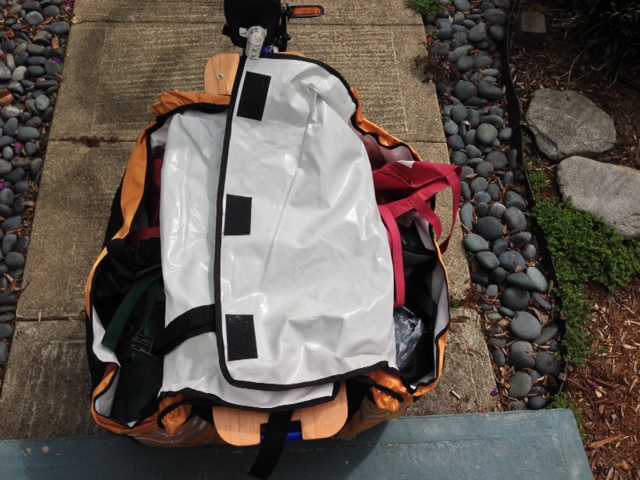
Taking a page from Joe George's blog, here's one example of TTCBCOAB (things that can be carried on a bike): Four bags of groceries, mostly fruits and vegetables, total weight - 42 lbs. A far cry from the Mundo's stated max load of 440 lbs. Added advantage - much easier to find parking at Monterey Market with a bike compared to a car.
 |
| Plenty of room left. Should've bought more? |

Monday, March 25, 2013
More Mundo Upgrades

The beauty of a cargo bike is that you can carry most anything you need. I've carried, on separate occasions: four full bags of groceries (about 90 pounds), 24 cans of dog food, two 14 pound bags of dog food, a dozen or so vegetable plantings, and so on. On recreational rides with my spouse, the heavy weight of the Yuba Mundo makes me a better (slower) riding companion. When possible, we've taken to devoting ourselves to making Sundays a gasoline-free day - no car, just transportation by bike or by shanks mare. And I continue to enjoy tinkering and modifying the Mundo, too.
A cargo deck for the Mundo's rear rack was something I wanted from the start, but the current bamboo cargo deck sold by Yuba won't work with the version 1 frame I have. A brief web search uncovered Joe George's post describing how he created a cargo deck for his Mundo. I decided to create something a bit lighter.
 |
| Started with 1/4" marine-grade plywood |

I decided to attach the deck using p-shaped clamps.


 |
| Finished product |
The next issue to be tackled was the seat post. You see, about 12 years ago I underwent lower back surgery to remove a L5/S1 free disk fragment. The surgery was very successful and cycling doesn't generally bother my back, but the Mundo's more upright riding position was proving problematic. Shocks and bumps were being transmitted more directly through my spine, resulting in back soreness. More investigation and research uncovered the Cane Creek Thudbuster seat post. Designed for hard-tail mountain bikes, the shorter travel Thudbuster ST seat post seemed to be good solution. I opted for the 27.2mm diameter version in the longer, 400mm version. This required a shim since the Mundo's seat tube diameter is approximately 30.3mm, but have no fear: Thudbuster.com has shims, too. Installation was simple and the results? No more sore back.

The original 6-speed drivetrain, while geared with a pretty low gear, was inadequate for carrying 100-plus pounds of cargo up the rolling hills of North Berkeley. So I acquired a SRAM triple-crank, clamp-on front derailleur, and shifter. Yet without a braze-on cable stop for a front derailleur, another solution was needed. Enter the ProblemSolver clamp-on cable stop.
 |
| Rear view |
 |
| Front view |
The last bit of customization, at least so far, was the addition of a whimsical decal. You see, I'd nicknamed this bike and for less than $12 (including shipping), Do it Yourself Lettering allowed me to ... well ...

Thursday, March 14, 2013
Night Bike, Urban Bike
Even with the switch from daylight savings time, it was already dark and almost 9pm when I started my bike ride home through Alameda, Oakland, and Berkeley. It had been a long day, but given my bike's lighting system, there was little concern. I'm not one of those ninja cyclists who dress in black and ride with minimal lighting. Given the late hour, spinning through the deserted streets of Alameda, thoughts of "What if someone tries to assault and/or rob me?" popped into my head, but no bogeymen appeared. Cruising along the Embarcadero, wedged between interstate 880 and the estuary that surrounds Coast Guard Island I heard the first distinct rumbling of the Amtrack Capitol Express. It was easy to hear, thanks to the whisper quiet belt drive on my Proletariat. The big engine would be paralleling the bike path on my right and the blasts from its horn began to shatter the cool night air.
I took my right hand off the handlebars to plug my right ear as the train began slowing for the highway construction and the Oak Street crossing. This meant I could pull ahead. The possibility of crossing the tracks at Harrison Street before the train signals and barriers could come into play became a distinct possibility. Escaping the train's blaring horn would be a fringe benefit. Before leaving work, I had the sense I might be catching a cold. I promised myself a leisurely ride home, but I couldn't help myself. I found my pedal cadence increasing. Possessed by a new goal, I had upshifted one gear and was now hauling ass. It was man against machine, David facing Goliath.
Looking over my right shoulder, I was clearly pulling ahead of the surreal beast. Three brilliant, blinding white lights, one of them sweeping like a search light in a circular pattern and behind the bright-as-day lights lurked the dark, menacing mass of thundering metal. Droning vibrations from the huge engine were being transmitted through the earth, along the pavement, through my bike's wheels, through the pedals, producing an odd tingling in the balls of my feet. The low, thundering rumble made the air in my lungs vibrate, but Goliath was losing, sliding further and further behind. A short downhill grade provided additional speed as I rounded the curve onto Harrison Street. The crossing signals began to sound and the gates lowered, but I was already through the crossing, my silhouette briefly illuminated by the dazzling lights. Wonder what the train's engineer thought of all this?
With the train three blocks behind me, I slid under the I-880 overpass, into downtown Oaktown. The streets here were mostly empty, too, save a few homeless souls, ranting to no one in particular. Following Telegraph Avenue into Berkeley seemed like the best choice, more heavily trafficked than Market or Adeline streets, more brightly lit than Mandala Parkway, more people, and probably safer. Telegraph was more lively and all of the traffic signals seemed to have been timed for little ol' me. A never-ending line of green lights, saluting at each intersection. Having vanquished the behemoth, my paced slowed. Several clubs with live music, booze and tattooed/pierced patrons spilling out and milling on the sidewalks appeared mirage-like on the periphery. They were a blur. I was focused on traffic, potholes, and the occasional shards of glass and strips of metal that appeared on the pavement ahead.
Veering off Telegraph Avenue onto the diagonal entrance to Shattuck Avenue, there were more cars but fewer people. Crossing Alcatraz, I glimpsed the unmistakeable flash of a bike's red LED tail light four blocks ahead. Another cyclist, another goal, my cadence increased again. Catching them didn't take long. A young woman with what, violin case strapped to her back? She nods as I pass and I utter a hoarse "'Evening." A quick jog over to Milvia Street, a designated bicycle boulevard. Now in my home territory, more relaxed, almost home. Twelve miles behind me, another four miles to go ...
Monday, February 18, 2013
Getting Serious About Energy
Over the past two years I've been gradually decreasing the time spent in a car and increasing the amount of time spent on a bicycle. Commuting to my work by bicycle started gradually, first combining cycling with BART, then gradually working to just the bike. So it was just a matter of time before the idea of a cargo bike would begin to take hold. A visit to some local bike shops and some research revealed a few basic choices - Xtracyle Radish, Surly Big Dummy, and Yuba Mundo. Further research indicated that the purchase of a new bike would be beyond the modest financial means of a professional flight instructor. Then a bit of luck came into play - a used Yuba Mundo became available.
This early version of the Mundo doesn't have all the features of the latest, version 4. Six speeds instead of 21, no disc brake braze-ons, no braze-ons for a front derailleur, no provisions for mounting some of the other accessories currently available. The first step was a bit of cleaning, polishing, and general TLC.
Both inner tubes had been mounted improperly and the valve stems were chaffed and worn. While replacing the front tube, I removed a handful of gravel from between the old tube and the tire - WTF! The rear tire had been installed with the tread oriented opposite the intended direction of rotation. The Kendra tires are heavy, but still they have plenty of life still in them. The chain was rusted and mostly devoid of lubrication. The headset needed lubing and tightening. With those chores done, it was time for some short, local rides to assess and plan.

One feature of the new Mundo frames is a spring device they've dubbed the "defloppinator" which keeps the front wheel from, well, flopping from side to side. Yuba's defloppinator sells for just over $20. My version? About $3.
Some more upgrades are in the works, but until then I've been using the bike for the purpose for which it was intended - Hauling stuff. A trip for groceries and soon I was pedaling home with about 80 pounds of grub, a mere fraction of the Mundo's 440 pound capacity. With the cargo bags loaded, the bike was surprisingly stable.
All of the tweaks and mods are great fun, but not as fun as riding a cargo bike. It's a different kind of cycling. Slower, but with a purpose and without fossil fuel.
 |
| Arriving home, courtesy of the very capable Yakima KingJoe Pro 2. |
 |
| Probably the version 1 Mundo frame. |
Both inner tubes had been mounted improperly and the valve stems were chaffed and worn. While replacing the front tube, I removed a handful of gravel from between the old tube and the tire - WTF! The rear tire had been installed with the tread oriented opposite the intended direction of rotation. The Kendra tires are heavy, but still they have plenty of life still in them. The chain was rusted and mostly devoid of lubrication. The headset needed lubing and tightening. With those chores done, it was time for some short, local rides to assess and plan.
 |
| Old Seat - not my cup of tea! |
 |
| Some breaking-in required ... |
 |
| Clunky ... |
 |
| Better ... |

One feature of the new Mundo frames is a spring device they've dubbed the "defloppinator" which keeps the front wheel from, well, flopping from side to side. Yuba's defloppinator sells for just over $20. My version? About $3.
 |
| Not as slick as the factory version, but quite serviceable and useful. |
 |
| Front and rear 60mm fenders. |
 |
| Sefras Thunderbolt LED light - USB recharging, 9 hour life, and very bright. |
 |
| Some tweaking of the rear fender was necessary |
All of the tweaks and mods are great fun, but not as fun as riding a cargo bike. It's a different kind of cycling. Slower, but with a purpose and without fossil fuel.
|
| Taking shape, bit by bit. |
Sunday, January 27, 2013
Affordable Care
My recent birthday was an important milestone and my health care provider, Kaiser Permanente, thought so, too. When the important day arrived, so did a notice from Kaiser. My health care premium was being increased by nearly $300 a month. Never mind that my blood pressure is 120/60, my resting pulse is 60, my body mass index is 23, I watch my diet carefully, and I bicycle 80 to 130 miles per week. The actuaries have spoken, my wife and I must pay the piper, and our monthly health insurance now exceeds our mortgage payment. At least we have coverage.
One of the key elements in the recent election was the cost and availability of health care, something that may not seem important to younger Americans. One doesn't have to look very hard to find sobering realities about the cost of getting health insurance and necessary care in the US. And one doesn't have to try very hard to find a friend of family member who has faced difficulties with health care. Some candidates and voter adhere to a "free market" approach while others take a more socialist approach to controlling costs. We may worry about rationing of care and we may even worry about financial ruin should we contract a serious illness or be injured. Others take a public health approach and try to reduce risky lifestyles and choices that lead to chronic yet preventable illness. The degree to which this all concerns us depends largely on our age and the current status of our health.
Cost is King
At its core, the free market approach assumes only those who can afford health insurance actually deserve the insurance. For decades health insurance was tied to one's employment as a worker benefit. If you were employed, you and your dependents deserved health care. In the 1980s, as health care costs began to climb, employers required employees to contribute to a share of the costs. Health insurance was restricted to full-time employees and additional charges were added for dependents. By the 1990's, most workers were contributing to a significant percentage of the monthly premiums. And now many employers offer health insurance options that are a shadow of what this benefit used to be.
Group Coverage
One way to reduce insurance costs is to spread the risk (or cost) for the few people who face a catastrophic illness across a larger group, yet more and more workers are no longer traditional employees. I'm a self-employed flight instructor. My wife is a contractor for the US federal government. We applied for individual health insurance only to find my wife was denied due to a medical history that included pneumonia. So our solution was to form a partnership and apply for group health insurance because under California law, group health insurance cannot deny coverage based on a pre-existing condition. We pay a higher rate than we would for an individual plan, but - as mentioned earlier - at least we have coverage.
What's Next
As many aging baby-boomers are discovering, we must hold out through at least two more cost increases at ages 60 and 65. Not-so-subtle ageism in a very difficult job market makes the prospect of being unable to afford any coverage an all-too-possible reality. In just over a decade my wife and I will be eligible for medicare, if such a thing still exists by then. In the mean time, we watch our diet, exercise regularly, do our best to maintain our individual health, and hope that we don't fall victim to any serious illness. For the time being, the market-driven approach to providing health care is king and woe unto him or her who cannot compete in the health care market because it's everyone for themselves. American society can't seem to afford to care.
Subscribe to:
Posts (Atom)